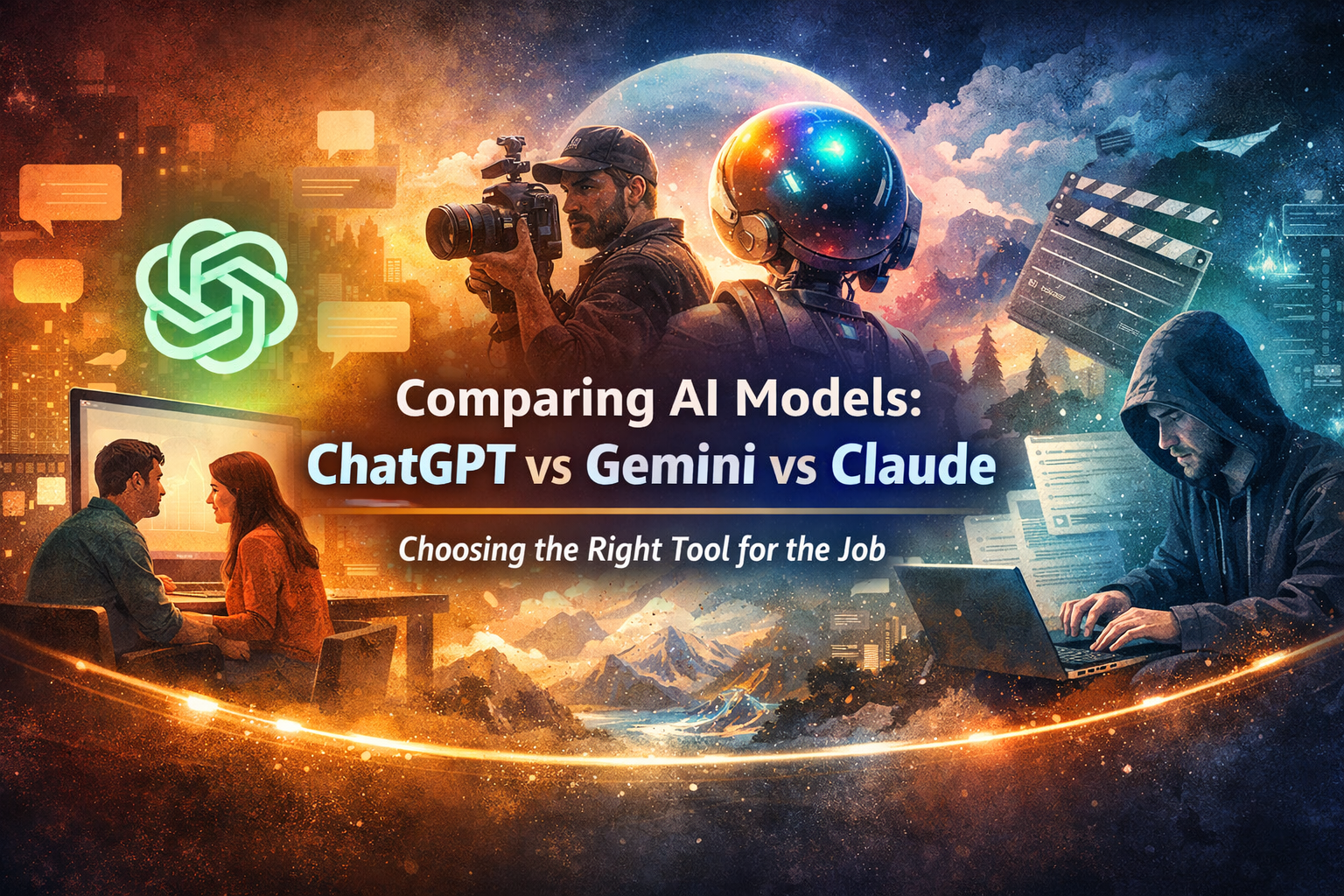
(A practical, honest overview — Part 1)
For the last year or so, I’ve been living with AI tools almost daily — for work, experiments, filmmaking, writing, and random late-night curiosity spirals.
And one thing I’ve learned the hard way is this:
There is no “best AI model”. There’s only the right model for the right job.
People often argue online like it’s a cricket match:
“ChatGPT is better.”
“No, Gemini is better.”
“Claude destroys everything.”
But that’s the wrong question.
The real question is:
What are you trying to do right now?
This post is a high-level, practical comparison — not benchmarks, not hype — just how these models actually feel when you use them.
This is also the first post in a small series where I’ll go deeper into each model later.
ChatGPT (OpenAI): The All-Rounder You Keep Coming Back To
If AI models were people, ChatGPT would be that one friend who’s good at almost everything.
You may not always notice it, but you keep opening it again and again.
Where ChatGPT really shines
General thinking & discussion
Brainstorming ideas
Explaining concepts simply
Career advice, planning, decision-making
Talking through a problem, not just solving it
It’s extremely good at contextual understanding — you can start vague, messy, half-baked… and it still keeps up.
I personally use ChatGPT when:
I don’t yet know what I’m asking
I want clarity, structure, or perspective
I want a conversation, not just an output
It feels less like a tool and more like a thinking partner.
Where it’s “good enough” but not always the best
Heavy creative visuals
Ultra-long documents
Hardcore codebase-level reasoning (depends on case)
Still, for 90% of everyday AI use, ChatGPT is the safest default.
Gemini (Google): Visual, Creative, Cinematic
Gemini surprised me — not with words, but with visual imagination.
If your work touches:
Images
Video
Animation
Storyboarding
Filmmaking
…Gemini starts to feel very natural.
Where Gemini excels
Image generation
Video concepts & prompts
Visual storytelling
Creative scene composition
For filmmaking and visual experimentation, Gemini feels like it thinks in frames, not paragraphs.
I’ve used it for:
Character designs
Poster concepts
Cinematic prompts
Story visuals
It’s less about logic and more about vibe, mood, and visuals.
The trade-off
Text discussions can feel less deep
Long reasoning sometimes feels lighter
Not my first choice for serious writing or planning
Gemini is not trying to replace ChatGPT — it’s playing a different game altogether.
Claude (Anthropic): Calm, Focused, Built for Depth
Claude feels like the quiet, extremely competent person in the room.
You won’t get flashy answers.
You will get clean, structured, thoughtful output.
Where Claude truly shines
Coding (especially logic-heavy or structured code)
Documentation
Long-form writing
Reading and reasoning over huge context windows
If you dump:
A massive document
A long codebase
Detailed instructions
Claude doesn’t panic. It just… works through it.
I reach for Claude when:
I’m writing documentation
I need consistency across long text
I want fewer hallucinations and more discipline
I care about structure over creativity
The trade-off
Less conversational
Less playful
Less “let’s brainstorm wildly”
Claude is excellent when you already know what you want.
So… Which One Should You Use?
Here’s the honest answer:
Thinking, planning, discussions → ChatGPT
Images, videos, filmmaking, visuals → Gemini
Code, docs, long structured writing → Claude
Instead of forcing one model to do everything, use them like a toolkit.
I personally rotate between all three — sometimes in the same project.
Why This Is a Series
This post is intentionally high-level.
In upcoming parts, I’ll go deeper into:
How I use AI in real projects
Filmmaking workflows with AI
Coding & documentation workflows
Mistakes people make while choosing models
Why “AI vs AI” debates miss the point
AI is not about replacing humans.
It’s about augmenting different parts of your thinking.
And different tools amplify different strengths.