Every week, another AI product launches.
Most of them promise to make us more productive.
Most of them generate something:
- AI Resume Builder
- AI Cover Letter Generator
- AI Interview Coach
- AI Email Writer
- AI Meeting Notes
- AI Research Assistant
- AI Chat
They’re impressive.
Many of them work remarkably well.
But after the initial excitement fades, they often end up solving the same problem: generating another piece of content.
That made me wonder whether we’ve been asking AI the wrong question.
Not: Can AI create this?
But: Can AI help someone make a better decision?
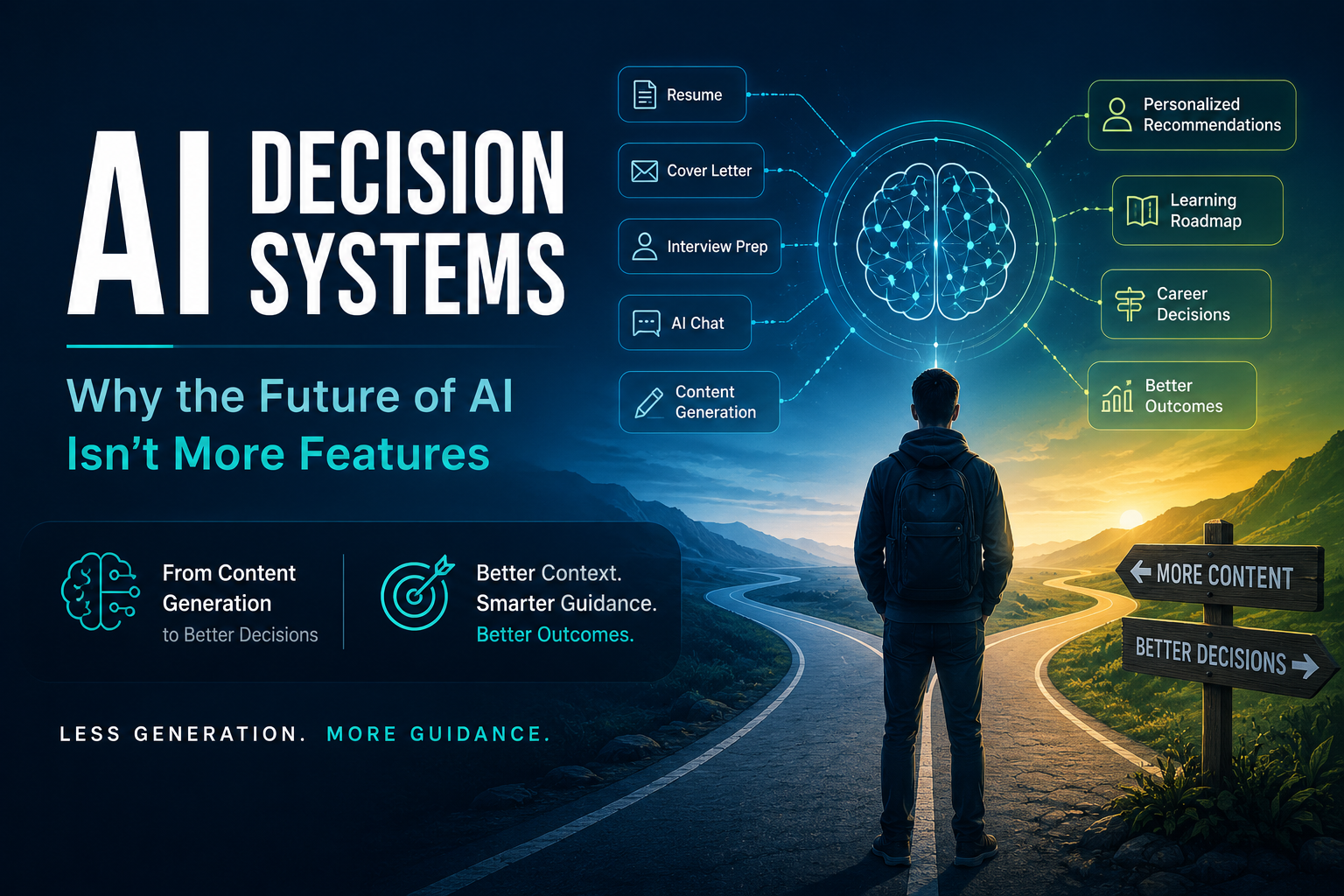
I believe that’s where the next generation of AI products will emerge. Instead of focusing on creating more content, they’ll focus on helping people make better decisions.
The Age of AI Features
Large language models dramatically lowered the cost of building intelligent software. What once required months of research can now be prototyped over a weekend.
That’s an incredible achievement.
However, it also created an interesting shift.
Intelligent features are rapidly becoming commodities.
Today, almost every AI product offers some combination of:
- AI chat
- AI summaries
- AI content generation
- AI recommendations
As these capabilities become standard, they stop being meaningful differentiators. The barrier to building them keeps falling, so competition naturally shifts elsewhere.
The question is no longer who can add AI?
It’s becoming who can help users make the best decisions?
Content Generation Isn’t Always the Real Problem
Take career platforms as an example.
Most of them help users create something:
- A better resume
- A stronger LinkedIn profile
- A more persuasive cover letter
- Better interview answers
Those are genuinely useful outputs.
But they’re usually answers to much smaller questions.
The bigger question often remains unanswered.
What should I do next?
Should I spend the next month learning Docker?
Should I build another portfolio project?
Should I improve my system design skills?
Should I focus on retrieval-augmented generation?
Should I become stronger in backend engineering before learning Kubernetes?
These aren’t writing problems.
They’re decision problems.
And unlike content generation, decision-making depends on context.
Good AI Decision Systems Need Context
Good recommendations rarely come from a single input.
Imagine two software engineers uploading the exact same resume.
On paper, they look almost identical.
Yet one wants to join an early-stage startup, while the other is targeting enterprise companies. One is preparing for machine learning roles, the other wants to specialize in platform engineering. One has six months to learn, while the other has interviews scheduled for next week.
Should an AI recommend the same roadmap to both?
Probably not.
The recommendation changes because the context changes.
That’s what makes AI decision systems interesting.
Instead of optimizing for better outputs, they optimize for better understanding.
From AI Generators to Intelligent Systems
One realization fundamentally changed how I think about AI products.
A single prompt can generate an answer.
A system can improve an entire journey.
Those aren’t the same thing.
Generating a resume is an event.
Improving someone’s employability is a process.
Processes require much more than a single prompt.
- Memory
- Feedback
- Iteration
- Context
- Trade-offs
Sometimes they also require multiple specialized components working together instead of one increasingly complicated prompt.
The interesting challenge isn’t making AI write more.
It’s designing systems that continuously refine decisions as new information becomes available.
Building Better AI Products Is More Than Better Models
It’s tempting to believe that a smarter model automatically creates a better product.
In reality, intelligence is only one piece of the equation.
Once you start thinking about long-term decision-making, the harder questions become product design problems.
- How do recommendations remain consistent over time?
- How should conflicting signals be resolved?
- When should the system explain its reasoning?
- What happens when hiring trends change?
- How does the product know whether yesterday’s recommendation actually worked?
None of these problems disappear with a larger context window or another model release.
They’re challenges of system design, feedback loops, and continuous learning.
Measure Outcomes, Not Features
One of the most thoughtful pieces of feedback I received after writing about autonomous career agents was this:
Whether it’s one agent or five matters less than whether the recommendations actually improve interview rates, offers, or time to hire.
I think that’s exactly right.
Users don’t care how many agents exist behind the scenes.
They care whether the system improves their outcomes.
That’s an important distinction.
Features are easy to count.
Outcomes are much harder to measure because they often take weeks or months to appear.
Yet outcomes are what users actually remember.
A recommendation that leads to an interview is infinitely more valuable than ten beautifully generated documents that never change someone’s career trajectory.
Why AI Decision Systems Could Define the Future
Today’s AI products are trying to do everything.
- Write
- Summarize
- Translate
- Generate
- Predict
The products that stand out over the next few years may not be the ones with the longest feature lists.
Instead, they’ll quietly help people make consistently better decisions.
Less noise.
More clarity.
Less generation.
More guidance.
That shift feels subtle today.
I don’t think it’ll stay subtle for long.
Final Thoughts
I don’t believe the future of AI belongs to products with the most features.
I believe it belongs to AI decision systems that understand context, learn over time, and help people navigate increasingly complex choices.
For me, that’s a much more interesting challenge than asking AI to generate another document.
Content generation made AI useful.
Better decisions might make AI indispensable.
The next generation of AI won’t win because it can generate more.
It’ll win because it knows what you should do next.